Hello and good evening from Ireland.
I am just getting started on my Dolibarr journey and have hit my first snag.
It seems when I enter a payment for an invoice to mark it as paid, it will create an entry in the bank account. This is undesirable, because my bank account is kept up to date via a tool I built to import statements from my bank. When the invoice module creates a payment, it means there is a duplicate entry in my bank account and throws everything off.
Is there a way that I select a bank transaction and inform Dolibarr that it is a payment for invoice, which then links the two, and marks the invoice as paid.
Many thanks
Conor
Hi @ronoc114
I think you can take a look at the bank reconciliation feature. If you click on your bank account, you’ll see a ‘Reconciliation’ tab. Try exploring that section to see if it helps.
Thanks & regards
Saikat Koley
Software Developer
Call/WhatsApp : +919903256573
https://www.linkedin.com/in/saikatkoley/
Hi
Thanks for your reply. Unfortunately there are no options there in reconciliation for invoice. It is very basic.
Can you do it on yours - perhaps you can share a screenshot?
Or if you have experience with developing on Dolibarr is it possible to make a module or some modifiction to enable the functionality?
Thank you a lot.
Hi
Yes, I’m a Dolibarr developer from India, and I completely understand your point. You’re right, the functionality you’re describing isn’t natively available in Dolibarr’s current bank reconciliation system. The reconciliation tool is quite basic and doesn’t allow you to directly link an imported bank transaction to an invoice in a way that marks it as paid without creating a duplicate bank entry.
To achieve what you’re looking for, the best approach would be to develop a small custom module that extends Dolibarr’s bank functionality.
Here’s how I understand the custom module will work (this is just an initial approach you may consider)
- The module would add a “Link to Invoice” button or action beside each imported bank transaction.
- When you click it, you can search and select the relevant customer invoice.
- The module would then:
1. Create a payment entry linked to the invoice.
2. Attach that payment to the existing bank transaction (instead of generating a new one).
3. Mark the invoice as “Paid” automatically.
Thanks & regards
Saikat Koley
Software Developer
Call/WhatsApp : +919903256573
https://www.linkedin.com/in/saikatkoley/
Hi @ronoc114
This does not exist in Dolibarr as such.
A module already exists that can help you achieve this : Banking monitoring
It let you import your bak statement via a CSV file and then you can reconcile or create objects from the specific reconciliation tab in the bank account. Furthermore, for a monthly fee, the process could be automated from your bank.
Hi there,
Can you please tell me the process your module with do, because right now it looks like when a payment is made, it changes lots of strange things.
I want to be sure that this will work before paying.
Thank you
Hi ronoc114,
i believe there were an option to match the invoices against any payment you have recorded separately, but you have to have activated Accounting module and it has to be set up.
Hi @nikolay86
If you don’t mind, could you please walk us through the steps and share some screenshots for clarity?
Thanks
Saikat Koley
Software Developer
Call/WhatsApp : +919903256573
https://www.linkedin.com/in/saikatkoley/
First you need to have Accounting module activated and set up.
Setup >> Modules/Application setup >> Accounting (double entry)
NOTE: The module have to be set up according to the company’s chart of accounts in order to work correctly.
Then, when a sales is recorded and invoice is generated there is 2 options how you can clear that document:
-
Open the invoice and post the payment directly through the document. This creates everything needed automatically and all links between the records are visible and built by the system (In this method you could also clear multiple invoices of the same customer without entering in each invoice). Then at the end of the period or whenever the Accounting person decides, all sales, purchases and bank entries could be transferred to the designated ledgers.
-
Entering payments by importing them or directly through Bank menu - you need to be aware of 2 things:
2.1. Chart of accounts must be set correctly
2.2. Subledger account for each customer/vendor must be active and their numbers must be entered in the master data section
In order to do enter a payment manually you might follow those steps as an example:
-
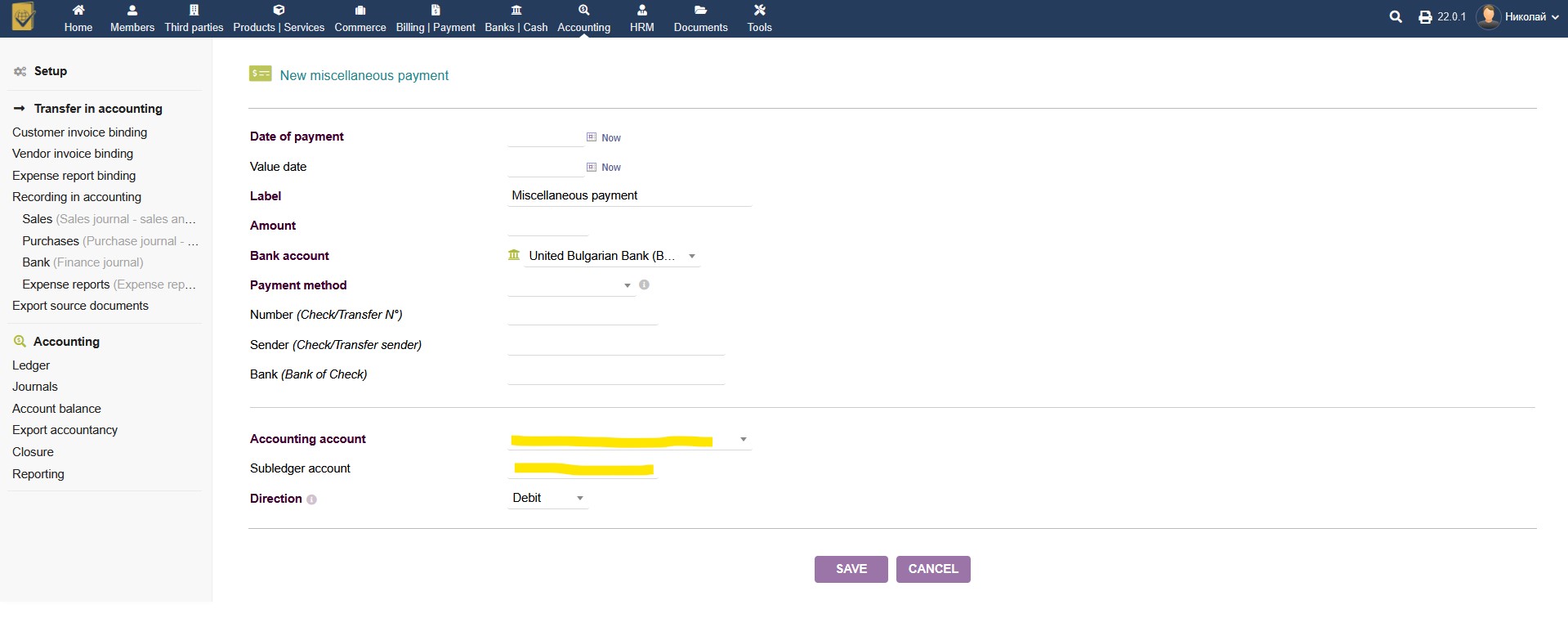
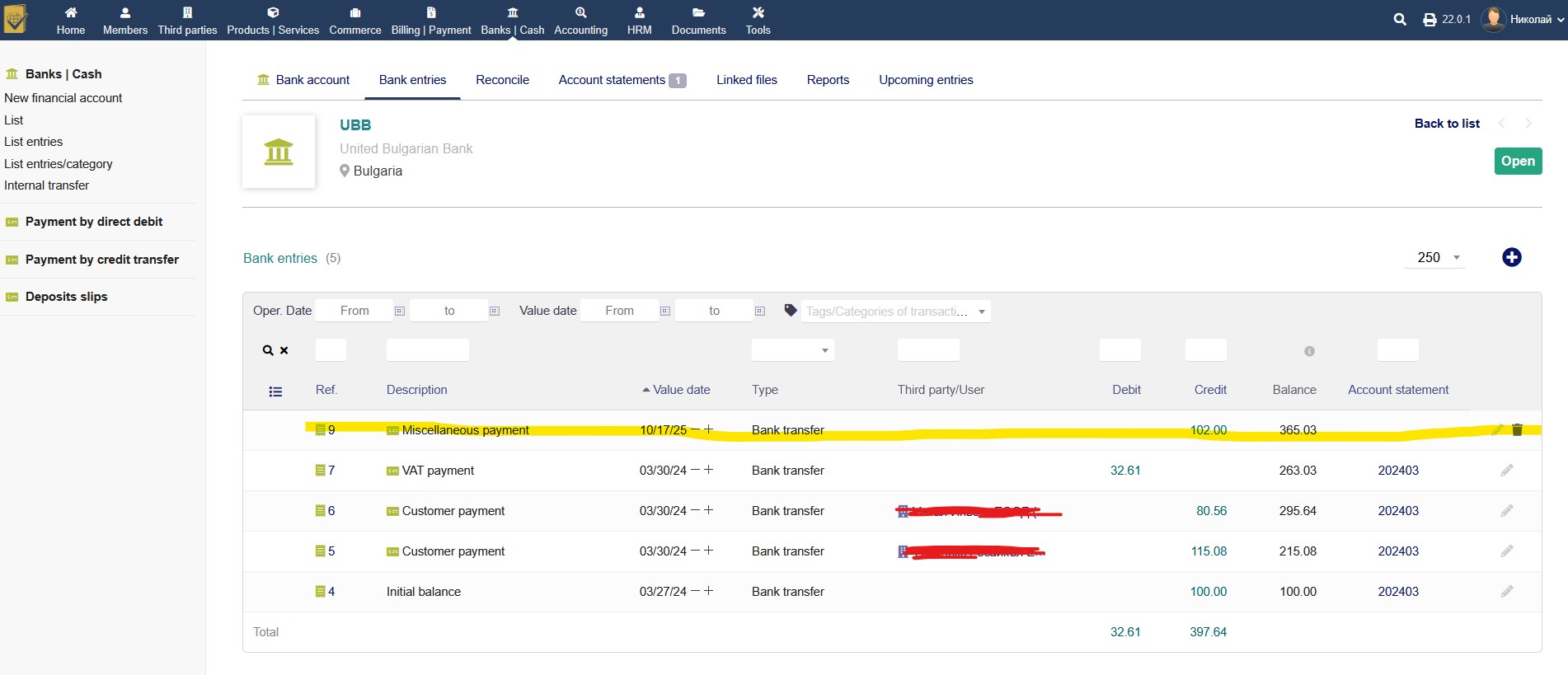
Enter the payment using Bank/Cash menu and then enter in to the bank account. After that go to Bank Entries and click on the (+) in the top right corner.
-
The yellow fields in the form have to be populated along with the rest of the fields
-
Then you may reconcile the record if you are using this option.
-
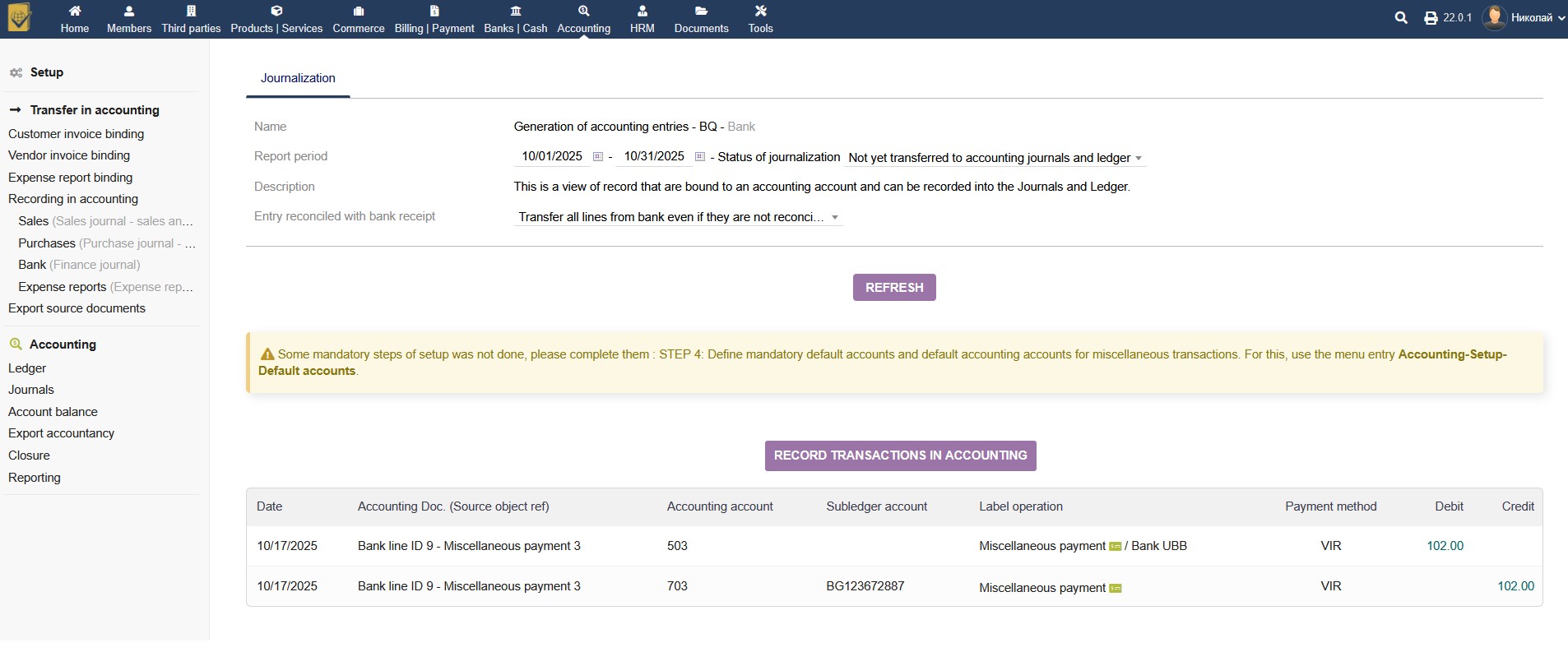
In the Accounting section go to Recording in accounting >> Bank, choose the dates and click on Refresh button. You’ll see something similar
-
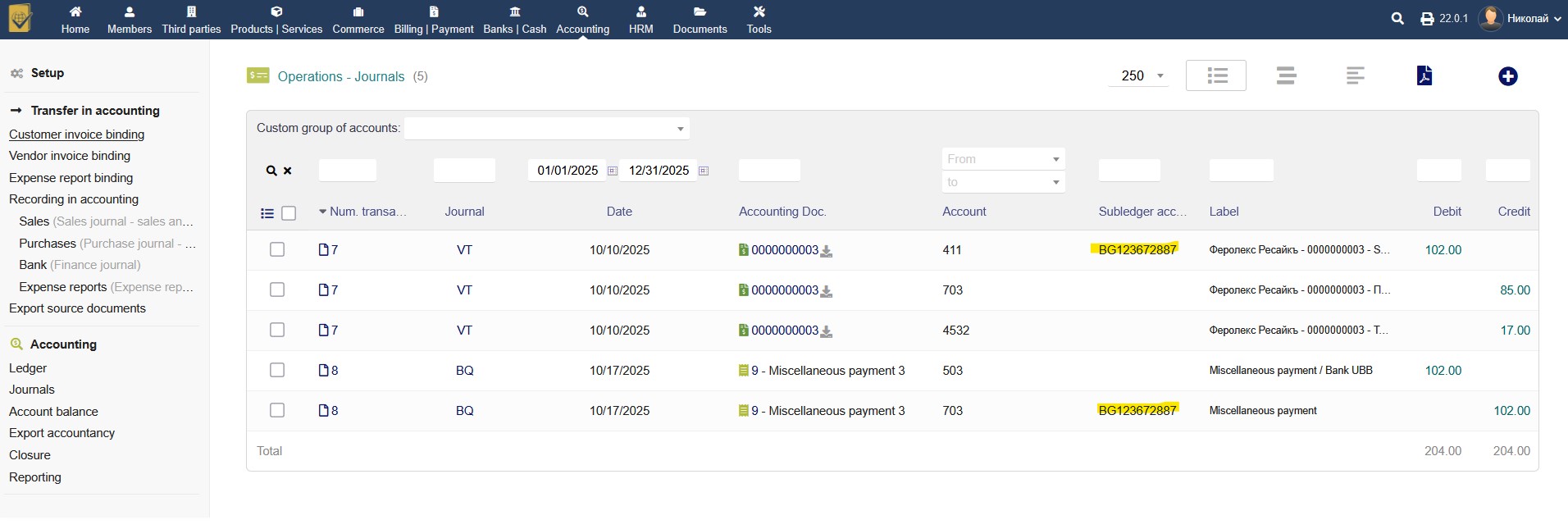
When you create all journal entries something like this will be visible as a result
A payment record in the bank ledger on the bottom row and the payment against invoice on the first row. The res of the records are automatically created and they represents a VAT record and record in the chart of accounts.
The main problem with this method (I haven’t steel found out how to solve it) is the invoice is still shown as not paid in the Commercial section. It is possible to click on Abandon button but it will not be good.
Another more complicated method is setting up and using SEPA functionality by creating Direct Debit and Direct Credit payment. This method requires a bit more information to be provided in the master data but it allows you to do multiple payments (credit and debit) at once and it will set the documents automatically to closed after the SEPA file is marked as complete.
Hi @nikolay86
Thanks for your detailed response. I’ll take a look at it.
Regards
Saikat Koley
Software Developer
Call/WhatsApp : +919903256573
https://www.linkedin.com/in/saikatkoley/
Hi Nikolay - Many thanks for this response.
It seems a very complex process in order to achieve a simple result.
I think I would like to have a simple custom module built in order to achieve this reconciliation problem.
I want a simple UI screen that shows me a list of bank transactions and then the option to link it to an invoice and mark it as paid.
Hey ronoc114,
i to tally agree with you. It would be much more easier but unfortunately there is no such functionality at this point and this is how we have managed to get the result.
Please let me know if you find something simple and easier, i’d like to have a look and adopt it to our system.
Right.
So honestly, while you have proposed works, but it is not a viable solution I think. I would rather not use Dolibarr if that’s how I need to reconcile my invoices lol.
I am looking at getting a module developed, perhaps we can share the cost and both use the module?
Hi Ronoc114,
The majority of small businesses use Quickbooks or Xero for accounting purely because this is what their bookkeeper/accountant will be familiar with and expect them to use + they have bank integrations and they are better at keeping up with changes to UK tax regime etc.
We have a hosted Dolibarr solution, this has ready made integrations with both Quickbooks and Xero + it has a lot of other stuff (advanced workflow calabilities, quality control, reporting, audit module, ready made integrations etc) that Dolibarr it’self doesn’t have …..on top of this it has GDPR level security built in and it’s on a resilient multi-data centre hosting environment for resilience.
This solution is used by startups, micro businesses and trafitional small businesses.
Mark I’d rather you didn’t spam my post with your sales pitch.
(The polite version)
Fair enough, was just trying to be helpful. Very very few UK businesses do bookeeping/accounting in Dolibarr, most bookeepers/accountants don’t want it to be done in an ERP as they all use Quickbooks/Xero this is just a ready made solution.