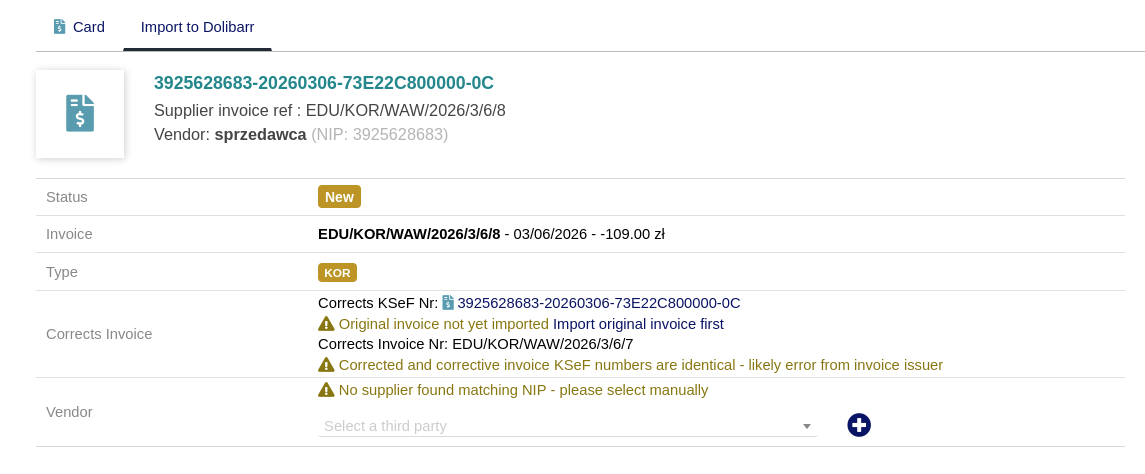
I’ve seen that a lot of test invoices are (incorrectly) using the corrective KSeF number in the XML for the corrected invoice KSeF number. This is likely an artifact of test data but since this pattern shows up more frequently than the proper one (where the KSeF number of the corrected invoice is put into the XML instead), I worry it is a common problem in production usage.
Therefore the module now checks and notifies for such XML errors when importing.
It also will request you to import the original invoice before importing the corrective invoice, so that the invoice linking in Dolibarr works properly.
v1.3.2 Released fixing cron job classnames, some calculation errors for missing fields, adding ability to have custom field mappings, and automatic translation application for these custom fields as well as more.
And a thank you to everyone who had found and reported issues so far, it helps quite a lot.
v1.3.3 released, addressing some last-minute issues - barring a critical issue this is last release before the KSeF system becomes mandatory for small/medium businesses.
I missed announcing v1.3.4 as it was a quick fix for some PDF issues, but v1.3.5 is released. Now queries the KSeF lighthouse for status/maintenance issues, including a new cron job, reworked the KSeF dashboard a bit, and a resolve a few issues that have come up.
Additionally, although there is complete in-module documentation in the “How To Use” tab, we also have finally finished a more detailed documentation with a bunch of screenshots which is available on our website as well in English and Polish. If you run into issues or think something is missing, please let us know and we’ll add it! I have added information about how to ensure the Bank Account information is added to invoices in the How to Use in the module, but this is yet missing from the website and will add it later today.
v1.3.6 released improving support for public notes and extrafields as custom fields on invoices, as well as a check to ensure that the module has been disabled/re-enabled after updates.
v1.3.7 released. Lots of fixes from the last few weeks both from github issues and from our own use. In particular I’d like to highlight:
Settings page is now split into 4 pages because it was getting too long
Can store credentials for all 3 environments and it switches between them when you switch environments, vs having to reconfigure
Invoice payment defaults can be configured (type, time, and account) so that they are autofilled on new invoices
Now properly handles invoice payments before uploading to KSeF
Various specialty VAT rates are properly supported
Way more options for how to include notes and extrafields from third parties, products, etc, as well as adding boilerplate notes that go on all invoice footers, and per-invoice or per-invoice-line extrafields as well
Through the magic of hooks I’ve managed to get Dolibarr’s “Replacement Invoices” to work as proper feature-complete “Corrective” invoices, allowing for increases/decreases/header changes/vat rate changes/etc, including for invoices which have payments. I’ve tested most of the cases I could think of and the example XML provided by KSeF, but when it comes to the double-entry accounting module there could be an edge case I missed, so if you do manage to find something that looks wrong, please let me know here or on Github.
One key thing to keep in mind is that for the corrective invoices, enter what the numbers or VAT rate or whatever should be. This is is contrast to credit notes (which also generate proper corrective invoices) where you enter what you want to return. There is a note above the fields reminding of this. For header changes, e.g. changing the address of a supplier, simply update the Third Party information and when you create a new invoice with no changes to line items (or also if you update both header and line items this is ok), the module will detect the change in the header and provide the correction accordingly, visible in the PDF preview. Of course, if you have an incorrect NIP to fix this requires a correction to zero and a new invoice.
In addition to this, the confirmation dialog with PDF preview of the invoice (both before sending and after it has been received allowing for quicker printing/saving of the PDF) is now completed and more uncommon FA(3) fields have been added. The PDF preview confirmation can be configured or disabled, and I rearranged the outgoing invoices options menu again (sorry for this, I think this is a cleaner final approach). And a few other minor changes/fixes.
v1.4.1 released. I did a pre-release window for the last week as it was difficult to be able to set aside sufficient testing time given the number of flags for more complex transactions that I am somewhat unfamiliar with the use of, but adds support for Podmiot3 and additional flags for other more complex transactions (such as MPP, reverse charges, self-billing etc), further improvements to PDF visualizations, and an issue with auto-generated products/third parties from imported invoices. Additionally, the update exposes an ‘advanced’ setting in setup→other settings to increase the communications timeout, in the event KSeF servers in your region are slow, and increased the default of this value from 5s to 7s.
v1.4.3 released fixing a few more issues including EORI numbers causing validation to fail, improving the PDF visualization, and a boolean flag to outgoing PDF options to add a date to the NrUmowy extrafield that is parsed out into the separate date/contract number fields of the KSeF PDF.
v1.4.4 released. Now has a “Check for Updates” button to settings to check GitHub for a new release, and supports GUS database for lookup of company data from NIP.
To use this GUS database, you must submit an email to request access to the service and be provided a key. A template email (pre-filled with data stored in Dolibarr settings) is provided in the how-to-use page and on the Authentication settings where the GUS lookup settings are located.
Closes out a couple issues and adds some more REST endpoints for integrations, as well as moving to using github actions for building releases. Of note is a setting to not include customer contact information that’s stored in Dolibarr (email/telephone) on invoices.
Good morning. Is it possible to create settlement invoices using this add-on? I have already created several advance payment invoices, but I haven’t found an option for a settlement invoice that is KSeF-compliant.
Very soon - I hadn’t run into this situation and nobody mentioned it until recently as a missing feature, this will be in the next update 1.5. The update has been in the works for a while now and there’s quite a bit more that will be in it as well

 left u a 5 star review on google, least i could do